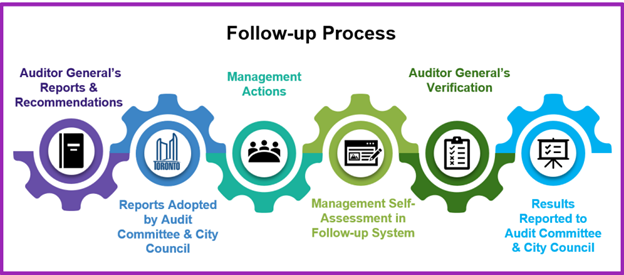
Why The Follow-Up Process Matters
The follow-up process provides accountability and transparency for City Council and the public by reporting on the status of the implementation of the Auditor General’s recommendations and the intended benefits.
The implementation of the Auditor General’s recommendations results in financial and non-financial benefits to the City, as reported in the Auditor General’s 2025 Annual Report.
The financial benefits identified in this follow-up cycle are estimated at $14 million. This includes $12.9 million from improvements in protecting revenue from fare evasion at the Toronto Transit Commission (TTC), $817,000 from better contract management of telecommunication contracts at the Toronto Parking Authority (TPA), $140,000 from recovering overpayments, and $124,000 from improved controls on utility payments.
Results of the 2025 Follow-Up Cycle
At the beginning of our review, there were 587 outstanding recommendations. Management reported 186 recommendations as fully implemented or no longer applicable. We selected 164 recommendations for review, including 96 from City divisions and 68 from agencies and corporations.
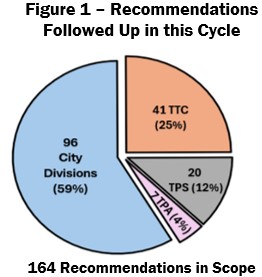
We verified the implementation status of these recommendations. Figure 2 provides the results for City divisions and Table 1 provides the results for agencies and corporations.
Progress in Addressing Auditor General Recommendations
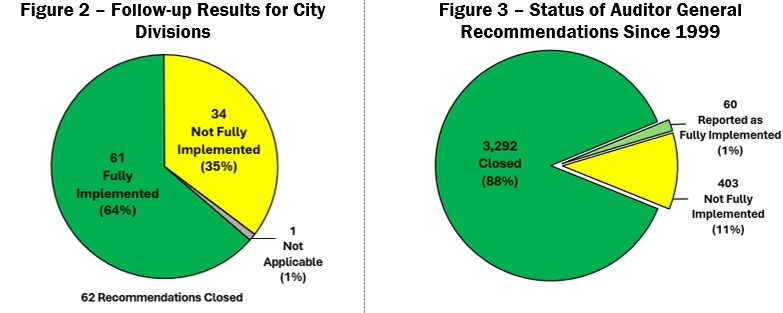
Since 1999, the Auditor General has made 3,755 recommendations in 432 reports issued up to May 2025. Of these, 3,292 (88 per cent) recommendations have been closed.
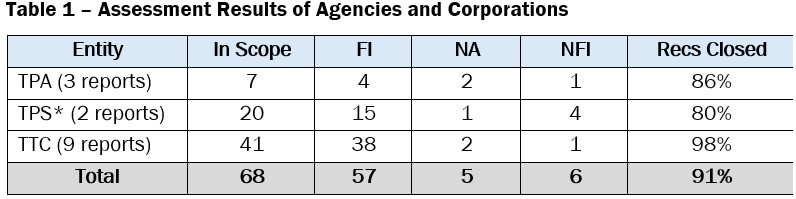
* Toronto Police Service
Areas Needing Further Action
Long-outstanding High Priority Recommendations
Recommendations that have significant potential for savings, mitigate health and safety or other significant risks, or have been outstanding for over five years are considered high priority.
At the end of this follow-up cycle, 163 of the 227 high-priority recommendations had been outstanding for five or more years.
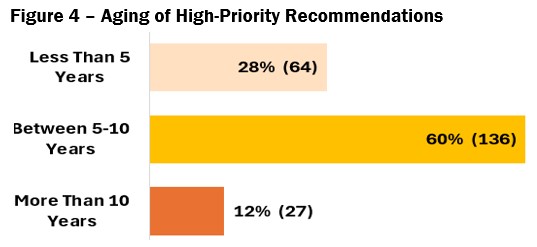
The implementation of these high-priority recommendations needs to be expedited to strengthen controls and achieve intended benefits.
Implementing recommendations that require City-wide action continues to be a challenge for certain City divisions.
Conclusion
Management’s actions to implement the Auditor General’s recommendations contribute to improved internal controls, more effective and efficient operations, and savings for the City and its agencies and corporations.
The Auditor General will continue to review actions taken by management to implement her audit, investigation, and other report recommendations, particularly those that are considered high priority.